

Application Penetration
Testing Services
Uncover Application Security Risks Before Attackers Do
Applications remain one of the most targeted attack surfaces across both legacy and modern environments. Long-standing business applications, customer portals, SaaS platforms, APIs, cloud-hosted applications, AI-enabled features, and third-party integrations can all create opportunities for attackers when security controls are incomplete, outdated, misconfigured, or not fully validated.
As application environments evolve, security risk can appear in different ways. Legacy applications may contain technical debt, outdated components, weak session handling, older authentication patters, or years of accumulated functionality. Modern applications may introduce complex authorization models, API exposure, cloud integrations, AI-driven workflows, and business logic flaws.
Zelvin Security evaluates application security from an ethical hacker's perspective to uncover real-world attack paths, validate meaningful risk, and provide clear remediation guidance before malicious attackers have the opportunity to exploit application weaknesses. The goal is to help organizations understand what matters most and address application security risks before they become business problems.
Application Penetration Testing Helps Organizations
- Uncover vulnerabilities before attackers discover them
- Validate application security controls through real world testing
- Improve visibility into practical attack paths
- Reduce business and operation risk
- Strengthen secure development practices
- Support customer security reviews and vendor assessments
- Support cybersecurity, governance, and procurement initiatives
- Demonstrate independent security validation to customers and stakeholders
- Receive documentation that includes remediation strategy, clear guidance, and risk-based prioritization
- Obtain a Letter of Attestation upon request, in additional to the final report, to support customer, vendor, and procurement security reviews
Zelvin Security provides independent third-party Web Application Penetration Testing designed to uncover vulnerabilities, validate real-world risk, and identify issues that could impact applications, users, customers, and sensitive data.
Schedule a free 30-minute consultation with our team of ethical hacking experts to take the next step.
Web Application Penetration Testing
Web Application Penetration Testing is a hands-on security assessment performed from the perspective of a real-world attacker. The objective is to identify vulnerabilities, validate whether they can be exploited, and determine the potential impact on application users, sensitive data, business workflows, or supporting systems.
Unlike automated scans that primarily identify known issues, Zelvin Security ethical hackers evaluate application behavior, security controls, and business logic to understand how attackers may attempt to gain unauthorized access, manipulate functionality, expose sensitive information, or compromise accounts.
Testing may be performed from unauthenticated, authenticated, and role-specific perspectives based on the application scope. This allows Zelvin Security to evaluate external attack paths, authenticated user risk, and whether different roles, permissions, workflows, or application functions introduce additional exposure.
Zelvin Security methodology combines structured testing, advanced tooling, hands-on testing and validation, human led AI assisted techniques where appropriate, and industry-recognized application security guidance, including OWASP Top 10, OWASP Web Security Testing Guide, and OWASP Application Security Verification Standard principles when applicable. Testing focuses on identifying meaningful risks that could affect the confidentiality, integrity, or availability of application data and functionality.
AI and LLM Security Testing for Applications
Organizations are rapidly integrating AI-enabled functionality into customer-facing and internal applications through chatbots, AI assistants, large language models, embedded workflows, automation, and third-party AI integrations. These features expand capability but also introduce risks that traditional application security testing was not designed to catch.
Zelvin Security's goal is not to slow innovation but to help organizations understand where security needs to be applied so they can build and deploy with confidence. Whether a team is experimenting with AI features or moving them into production, we focus on identifying practical risks, providing clear guidance on how to address it, not on whether something should be built.
Zelvin Security evaluates AI and LLM functionality as part of a Web Application Penetration Test when AI features are embedded within the application environment, or as a standalone engagement when the AI system, chatbot, assistant, workflow, or integration is the primary focus.
Testing typically includes:
-
Prompt injection and instruction manipulation
- Sensitive data exposure through AI responses
- Authorization and access control gaps
- Model-driven business logic flaws
- Excessive access to tools, APIs, or data
- Insecure AI integrations and third-party service exposure
- Unsafe handling of user-supplied input
- AI workflow abuse paths
Zelvin Security testing is aligned with recognized application and AI security principles, including OWASP guidance, with the objective of identifying practical AI-related risks that traditional web application testing may not fully surface.
Security Results that work with your organization, not against it.
Expert Assurance & Attestation
Documentation is designed to support:
- Procurement requirements
- Customer security reviews
- Vendor security assessments
- Cybersecurity assurance initiatives
- Internal risk management efforts
- Stakeholder and client assurance efforts
Strategic Documentation. Actionable Results.
A penetration test should do more than reveal application security issues. It should help teams understand what matters, what to fix first, and how to move forward with confidence.
A common concern after any penetration test is being handed a long list of vulnerabilities with no clear sense of where to begin. Zelvin Security reporting is designed to solve for that problem. Findings are organized by risk-based priority, tied to root cause, and paired with practical remediation guidance so teams understand what to focus on first and why.
Reporting is built for both technical teams and business decision-makers and may include:
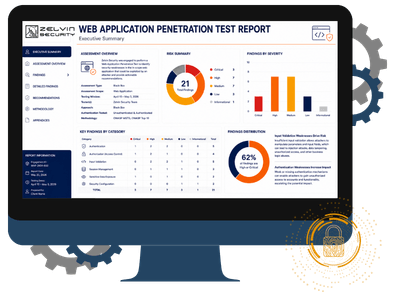
- Executive summary with visual risk overview and vulnerability breakdown by type
- Ethical Hacker's Perspective offering insight into how findings were identified and what they mean in a real-world attack context
- Root cause analysis designed to drive action, not just awareness
- Risk-based prioritization to help teams focus on what matters most
- Practical remediation guidance tailored to the application environment
- Supporting evidence and strategic recommendations
Our goal is to help organizations move from findings to informed action with clarity and confidence.
Independent Testing Actionable Results
Zelvin Security combines experienced ethical hackers, real-world attacker methodologies, and application security expertise to help organizations identify and address meaningful security risks before they become business problems.
Our independent, vendor-agnostic testing methodology focuses on uncovering actionable vulnerabilities, reducing false positives, and delivering clear guidance that organizations can use to strengthen their security posture.
From traditional web applications to modern AI-enabled platforms, Zelvin Security helps organizations better understand and reduce application-layer cybersecurity risks.
Want more than a vulnerability list? Request a free 30-minute consult with our team of ethical hacking experts.

Achieve Compliance and Confidence
We recognize the investment required to address the security risks identified during a security assessment. That's why the Ethical Hacking Team at Zelvin Security gives you an actionable strategy tailored to your technology, risks, and compliance requirements. This custom guide will save your team countless hours when it comes to remediation recommendations. Our team develops a plan to address risks at the root cause.
Schedule a call to get started
-
Ontime Security Testing
-
Stronger buyer confidence
-
Evidence-based findings
-
Prioritized pragmatic remediation steps
-
Testing aligned with enterprise procurement expectations
Proud Supporter of Tech & community
Web Application FAQs
-
What is a Web Application Penetration Test?
A web application penetration test is a controlled, ethical attack against your web app to find vulnerabilities an attacker could exploit. It simulates real-world threats and shows how to fix weaknesses before they are abused.
-
How long does a Web Application Penetration Test take?
Time depends on scope and complexity. Small apps can take a few days, medium-sized or API-heavy apps can take one to two weeks, and large or complex apps can take longer. We provide an estimated timeline in the proposal.
-
What exactly will you test?
Zelvin Security will test the application components you authorize, including front-end and back-end functionality, authentication and session management, APIs, third-party integrations, file uploads, business logic, and input validation. Using industry-recognized frameworks such as the OWASP Top 10, our ethical hackers identify vulnerabilities and attack paths that could impact the confidentiality, integrity, or availability of your application and provide clear, actionable guidance for remediation.
-
How do you define the test boundaries?
Boundaries are set in a written scope document. It lists domains, subdomains, API endpoints, credentials provided, excluded systems, and time windows. We will not test systems or assets not explicitly listed.
-
Do you test third-party services or cloud infrastructure?
Only if you include them in scope. For third-party platforms we typically test how your app interacts with them, not the provider’s underlying infrastructure unless you have explicit permission.
-
Do you need legal approval or a letter of authorization?
Yes. We require a signed Rules of Engagement or Authorization Letter that documents scope, timing, allowed methods, contact points, and an out-of-band emergency procedure. This protects both parties.
-
Will the test impact production availability?
We design tests to minimize impact. Some tests are intrusive and may affect availability. Those actions are agreed up front and scheduled during approved maintenance windows whenever possible.
-
How do you handle sensitive data you may encounter?
We treat all data as confidential. We follow secure handling procedures, avoid exfiltrating production-sensitive items unnecessarily, and recommend safe remediation paths. Data discovered is reported securely and deleted after the engagement according to the contract.
SAST, DAST, & DevSecOps
-
What is the difference between SAST and DAST?
SAST (Static Application Security Testing) analyzes source code.
DAST (Dynamic Application Security Testing) evaluates and detects vulnerabilities using manual and automated testing techniques to uncover security risks.
-
Why do we need both SAST and DAST?
Each approach covers different parts of the attack surface. SAST identifies coding flaws early in development, while DAST finds runtime and configuration issues missed by code analysis. Together, they provide a more complete security picture.
-
How does DevSecOps fit into this?
DevSecOps integrates security into the software development lifecycle as new releases are deployed security is implemented prior to the release. This brings security testing (like SAST, DAST, and dependency scanning) into each build, reducing rework, improving security, and speeding up delivery.
Secure SDLC
-
How is SDLC security different from Web App Pentesting?
Traditional security testing has happened after the web application is fully built and ready to go to market.
Secure SDLC integrates testing and compliance threat modeling throughout the development process.
It is more cost and time effective to integrate security into the development process to uncover risks earlier in the dev process. This makes it easier to build an app that is ready for compliance and technical security controls necessary, today.
-
How does Ai change the security of the dev process?
Yes, now more than ever, secure code development processes are at risk for integrated risks and vulnerabilities.
AI is fast, but not secure. This rapid cycle development style is not able to detect business logic flaws and consider complex compliance needs.
Zelvin Security helps organizations safely integrate AI-powered development processes, tools and source code into the SDLC. We integrate an AI-driven analysis, carefully tune automated testing tools to reveal true risks (and less false positives), and bring expert led SDLC security consulting services to your team.
We'll eliminate noise while fine-tuning security best practices with a security-focused accountability program.
-
What is Fractional SDLC Security Consulting?
Zelvin Security provides hands-on consulting to align your SDLC with NIST SSDF, SAMM, or BSIMM.
We'll bring training and accountability to your team, decades of experience improving security early in the dev process and establish security gates to align with the compliance frameworks required by your organization.